

Joining Our Trust
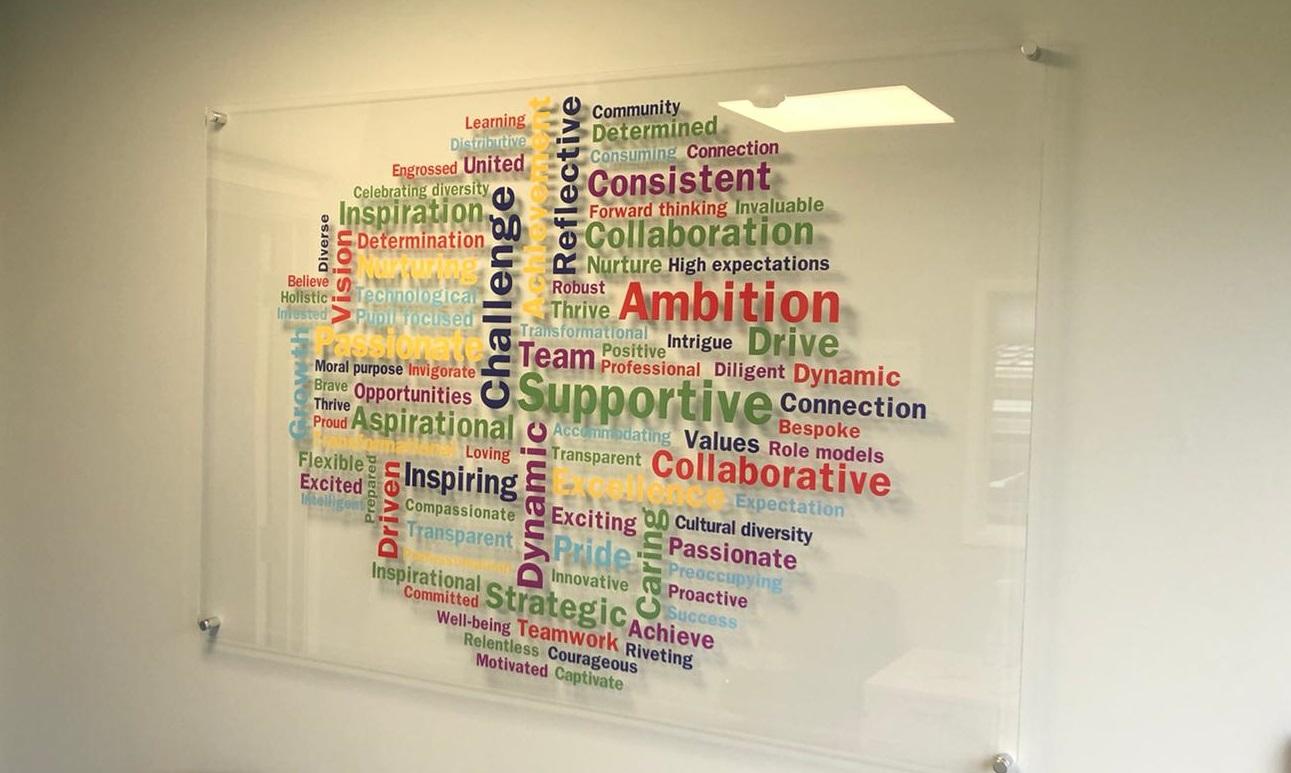
Leaders across our Trust brainstormed what they felt characterised our Trust: the wordle reflects their answers.
In 2017, Steve Munby, former CEO of the National College for School Leadership, gave a speech on ethical leadership in which he argued that the wrong question is,
‘Should my school become an academy?’
He said a much better question is:
“How can my school best collaborate with others in a strong and resilient structure to ensure that each child is a powerful learner and that adults have the opportunities to learn and develop as teachers and leaders?”
A group of schools working together in a Trust is so much more than changing of the legal structure of the school.
The 2022 Schools White Paper sets an ambition for all schools to join a strong trust by 2030. As we approach an election, a future government may take a different view, allowing different school structures to co-exist. It is for us professionals, with a duty to the children, families and communities we serve, to strive for what we believe will give every child the best possible start in life and not simply do what we are directed to do.
In strong trusts, there is a deep sense of collective purpose. In 2015, the cross-party House of Commons Education Select Committee published a report on ‘Academies and Free Schools’ in which they said:
“Primary heads told us that, whilst becoming an academy had improved their practice and their school, this was primarily because of the advantages generated by the collaborative framework of a multi-academy trust.”
Trusts create a collaborative framework – and can create the culture and conditions for pupils and education professionals to benefit from it: the capacity to link people through a shared belief about the identify, meaning and mission of an organisation.
A Trust is a group of schools working in deep and purposeful collaboration as one entity, under a single governance structure, to improve and maintain high educational standards across the trust.
Schools that have not yet converted to an Academy are invited to join us as. A partner academy will become part of the legal entity of The Island Learning Trust, ceding its governance to the Multi Academy Trust, whilst retaining a Local Governing Body, as outlined under the Trust’s Scheme of Delegation.
Key Benefits to joining The Island Learning Trust
- A strong school improvement team and a proven track record for school improvement/turn around.
- Strong supportive approach, with professionals in similar roles across academies sharing best practice, opportunities for staff to undertake research and shape new approaches/innovation.
- Innovative staffing arrangements: staff with specific skills working across more than one academy, family friendly working practices.
- Excellent career and professional development opportunities.
- A strong business team, high quality, shared services and sound financial management.
- An attractive work-life balance package for all staff.
- Westfield Health and Education Support benefits are in place for all employees

Why Grow
Our intention and ambition is to drive social equality and facilitate the empowerment of disadvantaged communities through education.
Children, families and communities deserve access to high quality schools that hold the highest ambitions for its children, families and communities. We feel a sense of responsibility and obligation to support schools to improve, either by providing support short of academisation or expanding to enable another school to benefit from the TILT experience.
It is our duty to build a network of schools able to support, inspire and enable our children and families to hold aspirations for themselves and believe they can achieve.
We will only expand when we have the capacity to do so. It is the responsibility of the Trust to build capacity.
Core Principles
Decisions regarding the growth of a MAT are made by the Board of Trustees ensuring sustainability and the ability to improve existing and new schools. These decisions regarding growth are communicated to the RSC who approve converter schools and advise the Secretary of State regarding sponsored academies and, in some cases, will promote schools towards our MAT. The neighbouring LAs are also made aware of our plans so interested schools can be signposted to us.
Principles relating to Trust Development
For our Trust to be able to grow and remain in line with our moral duty there are 6 principles that we hold firm:
1. Pupil well-being and achieving aspirational outcomes for our children is at the heart of what we do.
We create safe, nurturing learning environments with high expectations and challenge for all.
2. All working practices are positive, fair and built around a spirit of trust and co-operation.
We engage positively with our employees to create a happy and successful working environment. The Trust is an organisation which listens and learns, growing and changing organically.
3. Highly skilled, focused, competent and loyal workforce will enable pupils to make great progress.
We provide high quality CPD, monitoring and rewarding high quality performance and providing significant opportunities for promotion.
4. All Trust provision is judged at least Good by Ofsted (achieved within two years of taking on a school in category).
We focus relentlessly upon developing good pupil behaviour, great standards, imaginative and creative teaching and emotionally intelligent and resilient leadership.
5. All Trust provision is cost effective and expenditure never exceeds income.
We live within our means and maximise opportunities for economies of scale within a culture of careful resource management.
6. We have a moral duty to support schools in difficulty.
We engage in a thorough process of due diligence to ascertain whether each prospective school is viable in the short, medium and long term.
When considering readiness for growth the criteria below will be considered carefully:
How well existing schools perform in their Ofsted inspections, moving out of category, when applicable, and towards being good and outstanding schools and sustaining outstanding.
How all schools create environments that are deep-rooted in care and guidance for every pupil, ensuring their safety is paramount at all times.
A robust system for admitting converter schools into the Trust so that they add capacity and are not over burdensome or time consuming to recruit. There are risks associated with accepting 'requires improvement' or 'good' converter schools as there are often hidden difficulties.
Recruiting hubs of schools regionally, rather than individual schools ad hoc, so that they can be brought into the Trust more efficiently and not isolated.
Growth is linked to the quality and effectiveness of both our existing educational and service provision. The teams will take time to establish themselves in developing effective ways of working. Any growth should not compromise this and the Trust will need to be clear about their capacity to both embed the new structure and cope with any further growth.
Strategy for Growth
- We aim to have 8 primary schools working in hubs of across 2 to 3 geographical areas within 5 years. Maximum of 30 minutes travelling time between schools in each hub.
- Each hub will be driven by an Executive Headteacher with a highly effective Head of School in each Academy.
- The expanding MAT will inspire greater collaboration and innovation, built on current good practice.
- When a school is proposed or applies to be part of out MAT, we consider:
- moral obligation.
- size of school - any new school joining would need to be 1FE or above.
- financial position of the school.
- distance between schools.
- Ofsted category of the school.
The moral obligation to raise standards and address under-performance remains the overriding consideration.
Our Approach
- We work in partnership with schools, matching support specifically to their needs.
- We lead by example, using up-to-date methods.
- We are open, honest and professional in our approach.
- We recognise that every school has areas of expertise as well as areas for development.
- We reduce unnecessary bureaucracy and promote a positive work/life balance.
Development Priorities 2022-25
- To be ready to expand The Island Learning Trust by one school in September 2023, and then one school a year there after.
- To further develop leadership capacity across our schools, in readiness for growth.
- Evaluate Governance structure to keep pace with scale, demands and future challenges of the Trust.
- To evaluate and develop the Trust infrastructure for effectiveness and efficiency.
- To ensure all Trust provision will attract at least Ofsted Good when inspected next.
- Develop/adapt technology to improve collaboration and communication within the Trust.
If you wish to explore what The Island Learning Trust could offer you, your school please email: ceo@tiltrust.org
and we will be in touch with you.